NASCAR · Commercial treatment
Start your engines
It's a fuel-injected metamorphosis.
NASCAR is part of America’s heartbeat. It's been mainlined into the fuel system of this country for 7+ decades. Let’s witness how NASCAR’s been a part of those decades. We have to ensure this isn't a nod to history. It's an evolution of it. It's bringing legacy to life and downshifting toward the future. This isn't a memorial. It's not a history class - it's a fuel-injected metamorphosis that takes us forward and back through the triumphs, the tragedies the exhilaration, and the checkered flags that have made NASCAR what it is for 75 years.
It's the sound of an 800-horsepower engine like a chainsaw ripping through metal.
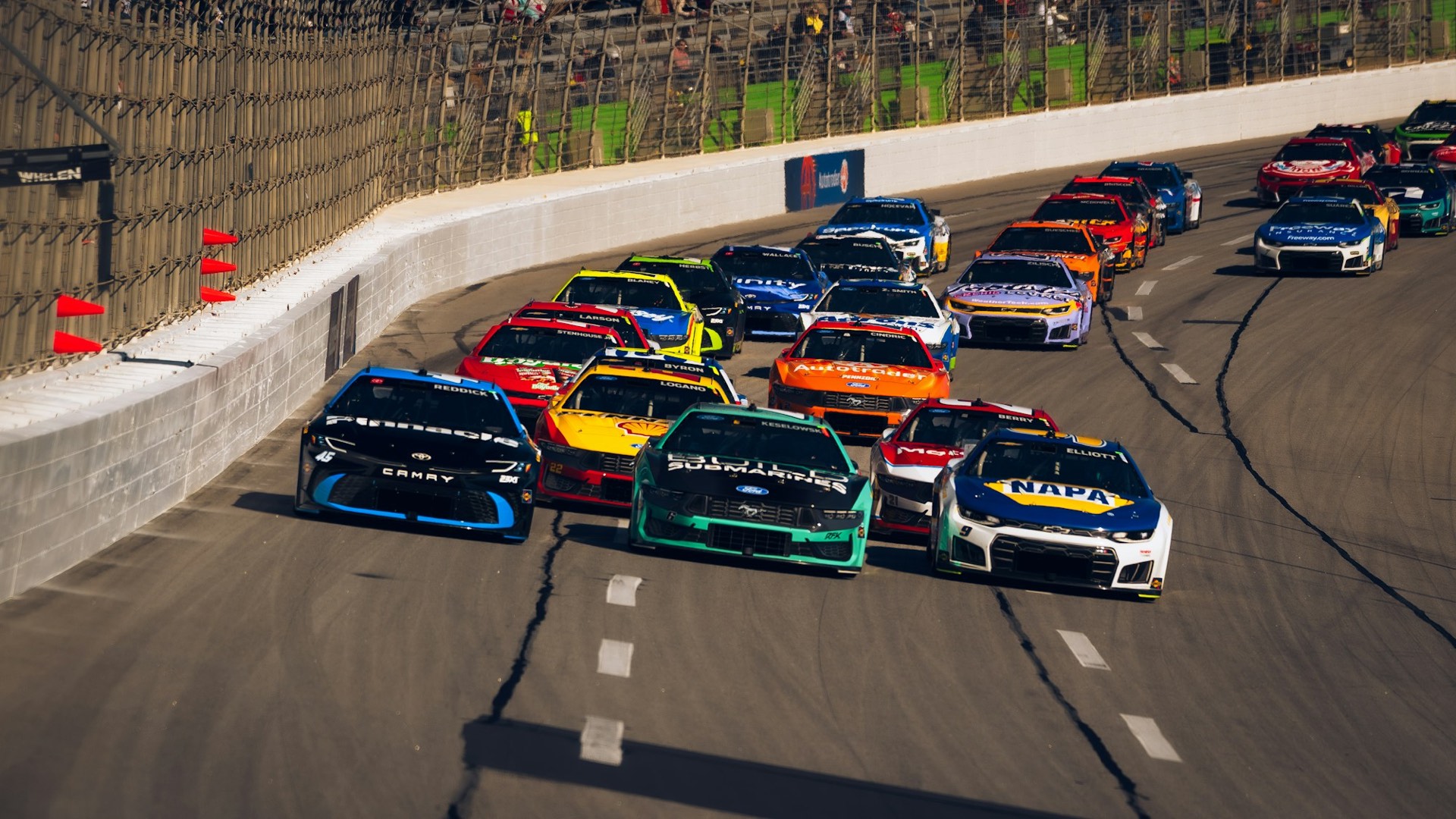
NASCAR isn't a company, it's not an organization, not some soulless corporate building somewhere. It's the sound of an 800-horsepower engine like a chainsaw ripping through metal. It's a 3000lb rocket on Goodyears kissing the wall at Talladega in a spray of sparks at 200MPH. It’s the sound of six caution flags, 20 lead changes, 100K people at the track, 20 million viewers worldwide – holding their breath as Denny Hamlin and Martin Truex Jr. come down the backstretch, door to door, wheel to wheel. Trying to spin the other one out. We don't have to sell this, don’t have to hype it. We just have to create the experience, the legacy, the racing heartbeat - that is NASCAR.
At no time will this be confused as a trip down memory lane. It's not that kind of ride. We're taking people on a visual-emotional-visceral journey that starts now, in the present. Then downshifts and accelerates the viewer through every NASCAR era that makes up its storied 75-year legacy.
The 75 car. It's modern sleek fast and badass. It's a visual mnemonic and a time machine. It’s what we place the audience into, secure the racing harness – then punch the gas. To a previous era. The constant is always the thrill, excitement, and win-at-any-cost, of NASCAR. What moves us through the eras is the 75 car. We begin on the 75 car. It's sending it down a backstretch. G-forces trying to pull it into a wall. Roaring 358 engine outmuscling physics to hold its line. Then in a beautifully analog way the hood begins to pixelate, a bit like an out-of-tune 80s TV signal. This effect ripples down the length of the bodywork to reveal the white bodywork of Buck Baker’s 1956 Ford Mercury underneath.
The effect isn't editorialized. It's glitchy, real, happens as we watch. The kinetic vibration of a car bouncing down the track at 200+, the sound of the engine, the plea of machinery fighting the will of physics to tear it apart.
As the 75 car changes through the decades – the flicker, transitioning effect never changes. Not altogether. But it gets subtler. The transition to Buck Baker’s 1956 Ford-Mercury is blockier and grainier than the transition to Denny Hamlin’s 2016 FedEx car. The flickers are more obvious when the 75 car changes into a 1956 Ford-Mercury. Less obvious between the 75 and the Fed Ex car. On the backend of the spot it’s More like watching an F-22 flicker-transition into an F-18 fighter. As opposed to an F-22 changing into a biplane.
We’re taking the audience on a breathtaking ride. From the beginnings of NASCAR throughout its pivotal moments in history. Each era feels seamlessly connected. It's never sentimental. There's no time for that. we pay homage to the past by living it again. Right now. In the time it takes to downshift into a left turn we’re in 1999 - Bristol Motor Speedway, Dale Sr. puts his bumper into Terry Labonte’s #5 car which fishtails into a corner. We downshift, hold the wheel tight – boom, now we’re at Daytona, the 500 on Feb. 18, 1979. Cale Yarborough just threw and dodgeball’d his helmet off Bobby Allison’s face – who now has him by the foot, throwing haymakers at his head. We cut – we’re at Talladega, fans on top of their RVs, hoisting beer in cans. A NASCAR down the stretch – fire spiraling up from under its chassis. Engine belching curls of smoke. Car doing 214MPH, last dash to the flag. We’re not recreating memories. We’re time-jumping the viewer.
We’re not recreating memories. We’re time-jumping the viewer.
We open looking up at a colorful modern parasol with the sun behind it, the edges flapping in the breeze. A title comes up ‘Daytona Beach’ and fades away. We can hear the sound of seagulls and waves breaking on a shoreline. We cut wider to reveal we are on a flat wide beach where a family has camped out with their parasol beach chairs and cooler. The sea behind them glitters as a ribbon of light in the sunlight.
A little girl is playing in the foreground on her mum’s phone, mum and dad sunbathing or asleep on the chairs. All is quiet. The girl hears something and looks around curiously. We hear the distant sound of an engine roaring. Faint – but an unmistakable, low roar. She shields her eyes from the sun as she stares. We cut to see past her, a car approaching, it's moving fast, very fast. We cut in close, racing alongside to reveal it is our Ford 75 car racing across the sand. Dust devils of sand spiral up behind in its wake.
Suddenly the front part of the 75 car flickers and shifts like a bad TV signal. This analogue effect ripples back and across the car across the bodywork to reveal the form of Buck Bakers white 1956 Ford Mercury underneath. Simultaneously, the color image becomes grainy and contrasty, like it would in the 1950s. Cut to the same car in the original race footage from that era as it races round the Daytona beach track on the corner that takes the track off the beach, where the sand is rutted and churned up. We see other cars racing alongside. We cut to a low-angle shot on the edge of the track as Buck Bakers' car flashes dramatically past camera, churning up the sand in its wake.
We cut to a section of the 1950s crowd on the beach section of the Daytona racetrack – people yelling, waving the drivers on as the cars flash past on the track. A guy holds up his Kodak camera, manages a shot as cars blur past. We cut to a member of the pit crew as they step forwards with a board for the driver to read, then cut to see a car flash past him.
VOOne minute we’re going 110 down a sandy beach in Florida and the next we’re bumper to bumper at over 210 mph on a superspeedway.
We watch the 1950s color footage as the cars race round the Daytona track. Then Buck Bakers Ford flickers back into the 75 car. We cut to 1987 at Talladega, but still watching the 75 car on the track, before it flickers into Bill Elliott’s #9 car when he reaches 212 mph. In the pit lane we see two men using a 1980s-style speed gun – one guy looks at the readout: 212. They turn, silently trade looks, disbelieving. We see a shot from the 1980s - fans climb the cyclone fencing to get a better view. One guys got his hand on his buddy’s back propping him up, while he uses two hands to cheer the cars on. A shot of a 1980s crowd whooping and hollering, quickly looking from right to left as cars flash past. It sounds like Jet fighters just took off. And never left the runway.
VOHow the heck did we get here? Progress, that’s how.
We cut to an abstract shot looking through the guard rails, as 1980s cars roar past in a blur of sound, light and color. We cut to archive footage from 1999 at Bristol Motor speedway, with the Chevrolet 75 car embedded in the footage, then see it transform into Dale Earnhardt’s #3 Monte Carlo. We see him bang doors with Terry Labonte’s #5 car on the final lap. We see a section of the 90s crowd react, then cut back to see Earnhardt put the bumper to Labonte and knock him into the corner. We see a pit crew celebrating like crazy (include Gif of this)
VO75 years of it. 75 years of twisted metal and foots made of lead.
We cut to see a montage of violent crashes over the years, cars into the wall in a rain of sparks, flying debris airborne like metal confetti, a car corkscrews, airborne, explosions, fireballs shoot into the sky, ribbons of black smoke follow. Cut to see two unidentified 1970’s drivers fighting in the pit lane – no holds barred, looping punches, handfuls of each other’s fire suits in hand. Pit crew members try to separate them. Then join in the melee. A driver throws his helmet at someone. Anyone. This is NASCAR.
Of banging and bumping and rubbing. Of fighting for everything and not giving away an inch
We cut to the fight between Cale Yarborough and the Allison brothers in 79, (we’ll recreate the fight with stunt doubles, in matching costumes shooting any extra angles that won't reveal their faces). Cut to a section of the crowd reacting or someone on the roof of his RV standing to shout, yelling. Then takes a swig of beer from a can. We see the crash between David Pearson and Richard Petty at Daytona in 7. Tony Stewart throwing his helmet, Portraits of Danica Patrick, Kyle Busch and others.
VOBut this ain’t just about the 75 years of legends behind the wheel, it’s also about them...
We see various shots of NASCAR crowds through the years: some archive, some new footage. A mom with a beehive hairdo screaming her car to the finish line, holding a cigarette. A section of crowd from the 50s yelling their heads off.
A 70s crowd reacting to a famous win.
We see a group of fans from the 90’s atop their RV parked on the infield. They’re doing a victory dance, waving a sheet with their favorite driver’s car # written in sharpie.
and then...
...the noise of the engines dies for a moment. We cut away from trackside to see a group standing outside a TV store in 70s Midwest somewhere, staring at the screens in the window – an old farmer, a kid on a bike, a woman pushing a pram. Unmoving, like they were trackside. The kid gives a little fist pump. The old man nods, knowing his guy has to make a move now.
and him...
We see a kid who has climbed the fence – fingers laced through the fence, holding on watching the cars race by.
or
We see the guy with the chequered flag wave it like crazy – the traditional weaving motion, flag fluttering.
oh and them...
We see a pit crew racing around a car that’s in for a pit stop.
VOAnd it’s also about the 75 years of 4-wheeled rocket ships, piloted towards infamy.
We see an explosion of fire from an exhaust – flames spit out angrily. We cut to abstract blurs of light and color as the #75 car races around a track. The car sticks to the turns like a magnet.
We see an archive footage shot of the 1950’s era cars racing just past camera on the sand at Daytona beach. We cut to a trackside shot from the 1970’s era as cars flash by, then jump cut to the 1990s, whip panning with a car as it passes. We track with it on the course as it approaches a wall of grey smoke from a crash. The car rockets through it – transforms into the Toyota 75 car.
VOEach one hell bent on wrenching more speed out of each cylinder. Each one built with one thing in mind...get out front and stay out there.
The 75 Car transforms into Denny Hamlin’s FedEx car from the 2016 Daytona 500. We see the historic photo finish between Hamlin and Truex. We see a close abstract shot of cars passing over the finish line.
We see a detail of the checkerboard pattern chequered flag being waved. We see a section of the crowd go wild and one character in particular going crazy. Then a montage of wins by the future of NASCAR like Daniel Suarez, Chase Elliott and Bubba Wallace
VOCause out there is where progress is. Out there is where the future is.
We see a burnout from one our of current-day drivers. Suddenly from the smoke emerges a futuristic NASCAR stock car. It peels off and transforms back into the 75 Car as it heads off into the distance away from camera.
VOAnd if the first 75 years is any indication, the next 75 is going to be a white-knuckle-hair-raiser. Buckle up, butter cup

VONascar. Always Forward.
The fans are as much NASCAR as the checkered flag.
75 represents every race, crash, pull-from-behind victory and pit row fight from then – until now. It also represents the people. There's no more loyal fervent raucous fan base than NASCARs. They're family. And they've been there – and here, from the beginning. Along with the racing we’re seeing the fans, the family, the culture of these diehards through the eras. The fans are as much NASCAR as the checkered flag. Let's recreate elements of the fan base trackside in each era. We can create a 60s-era commentator booth. Old-style pedestal microphones. Combovers. Do a match cut from the mic – to a mic in the 80s. Recreate that booth, 80's era.
Same with the crowds – in the 60s, people just off track – barely separated from Richard Petty's Plymouth Fury by some cyclone fencing and a low concrete barrier. We see the fans – then whip pan – and we're in the '80s. Still fans and the culture, now in a different era. People atop their RV's, cooler of beer within reach. Wives in tube tops, feathered, blown-out hair. We downshift quickly, easily, efficiently through the eras. We create the racing (cars) in the BG as now-you-see-it, now-you-don’t blurs. A roaring, indistinct shape of primary colors and reflection of light whisking past frame.
In these moments our focus is on the fans - the people - the humanity. The 100,000 at-track fans who are the support team behind the pit crew, behind their driver. Maybe we find one fan in the 60s - a wide-eyed, sandy-haired 13-year-old, fingers stuck through the fence watching his hero's blast by him, feet away on the track. We pick him up again in the crowd, 15 years later. At the track again – fingers laced through the fence. His 5-year-old son, next to him. Because NASCAR is legacy. So are its fans.
It's the past being lived again – right now.
Sounds like you've access to a wealth of archival treasure. it's a surprising/wonderful aspect of NASCAR that for all its global viewership - at various points in the past it was covered by a guy with his shoulder- held camera and his buddy from News Channel 2 in Tampa. We'll take all the stock/archival available. For our recreated scenes (60's announcers in a booth, a segment of the fans in the stands) we'll faithfully recreate the looks, props, style and shoot period-correct camera – 8/16MM. Grainy, raw, scratchy, shaky. It's a linear journey through different eras. But it’s an experienced journey. It’s not sliced-together footage trapped in history. It's the past being lived again – right now. It's visceral and exhilarating. Real, relieved.
At no time would I ever dream of asking Dale Jr. to take me on a research drive between set ups. Unless of course, he wants to. Had a great bit of fun mapping this out, appreciate you sticking about to read it.
Best to all.
Photos: Casey Calhoun, eloy and Tim Trad on Unsplash.